Spring Concert - Saturday, 7th March 2026
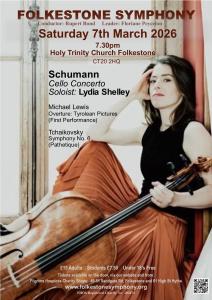
Michael Lewis - Overture: Tyrolean Pictures (First Performance)
Schumann - Cello Concerto
- Soloist: Lydia Shelley
Tchaikovsky - Symphony No, 6 (Pathetique)
Holy Trinity Church,
Sandgate Road,
Folkestone,
CT20 2HQ

Review
Rupert Bond, the conductor, opened this concert by noting we’re looking forward to a warmer English spring in these first days of March and the contrast between the gloom of winter and the balm of the season ahead was very much in evidence right from the start of this entrancing programme when local composer, Michael Lewis introduced his Overture: Tyrolean Pictures. It proved indeed to provoke thoughts of cheerful times as a tremendous percussion section took us swinging into the typical rhythms of Austrian music. The full orchestra coped expertly with the composer’s teasing out of a variety of three beat phrases – sometimes over more than one bar. Particularly impressive here were the horns when they took on the role of Alpine horns. Here was a piece which managed to evoke a 21st century sound from traditional music. The final section was tremendous fun – an oompah band joining the holiday atmosphere, leaving the audience basking in southern sunshine.
The choice of the Schumann Cello concerto was perfect for this programme. It is a quintessentially Romantic piece which, although written at a tragic moment of depression, offers warmth and melody in abundance. Schumann was particularly aware that the low tones of the instrument meant that there could be a danger of the soloist being overwhelmed. Thanks to the authoritative leading of Floriane Peycelon, the balance between soloist and orchestra was never compromised. Playing without music, soloist Lydia Shelley gave an engrossing performance, her impressive technique melded organically to the emotional range of this piece. With three movements compressed by the composer into one, neither orchestra nor soloist is allowed a moment of rest and the energy of the performance was a joy to witness. Unusually the middle movement is a duet between soloist and principal cellist - a delightful moment of repose before the animated finale (with a fine accompanied cadenza of vibrato playing) led to a spirited ending.
Completing the evening of powerful music was Tchaikovsky’s Pathetique symphony –a piece well known for its depth of passions and one which sets a major challenge even for professional orchestras. Thankfully, in Rupert Bond this orchestra has a conductor hugely capable of inspiring the tenderness and contrasts required. As the piece began with its dark brooding mood beautifully phrased by principal bassoonist Nick Ward, the packed audience were held spellbound as flutes, oboes and clarinets plaintively developed the theme. The strings have much work to do in accompaniment and the dextrous bowing made the playing seem easy (it isn’t!). The movement ended with some powerful brass playing forewarning us of the tragedy of the last movement. The swelling trumpets and horns echoing over the elusive descending chords of the lower strings made for a moving end to the first movement. In contrast, the waltz- like second movement was a joy to hear and the players were so obviously enjoying every minute of making music. After the dance comes one of the most exhilarating marches of all symphonic writing – an orchestra of expert players will raise the temperature so much that the audience will not be able to resist applause at the end. And so it was here. Folkestone really does have an orchestra equal to the professionals.
It was a lovely touch to have the seconds positioned opposite the firsts in order to highlight the combined strands of melancholy – and it was a move which was rewarded as the strings shared the plaintive descending motif of the last movement. The excellent trumpets and trombones brought the turmoil and despair to a climax, leaving us to experience that sense of wonder which only live performances can bring until the final double bass notes faded into stillness. When the enthusiastic applause came it was a fitting tribute to a musical director and orchestra which gives such pleasure to its players and supporters.
David Pestell